Internet of Things Market: What Can We Expect?
Find here a paper that takes a look into an evolution of market landscape and trends driving the Internet of Things (IoT). Since these technologies are still in development, and there are no standard definitions yet, what impact can we expect on the market?
The paper discusses all stages of development of such technologies: passive tracking, more-active interactions, a more aware landscape of physical objects, devices, and structures, and finally, an autonomous landscape that is created. Also, it looks into early-adoption scenarios, potential inhibitors to the Internet of Things, key takeaways and more.
Book a demo today to see GlobalDots is action.
Optimize cloud costs, control spend, and automate for deeper insights and efficiency.

Download the full paper here.
Private Paas: Next Generation Cloud
If you have used Google App Engine, you are already familiar with PaaS (Platform as a Service) functionalities. There are other early public cloud adopters such as Heroku, or Engine Yard.
But, what about private enterprises? David Linthicum takes a look into how enterprises can start to adopt platform cloud service and leverage a private one to avoid risks of security and governance. “The answer lies in understanding new models of delivery, such as private PaaS,” Linthicum explains, “moreover, there are emerging patterns of use that provide more business agility. These include standardized business solutions development, such as a common business system, or a cost-effective platform to build and externalize services to customers and partners, such as providing and managing web services that allow controlled access to core business data or processes from outside the organization — in essence, turning the enterprise into a cloud provider.”
Furher on, Linthicum comments: “IT wants to get out of the cycle of endless hardware and tool upgrades. We need to centralize and standardize development around a common toolset and platform that will support how applications are built for years to come.”
Find his paper here that examines the rise of private PaaS, the PaaS market, the PaaS value, PaaS technology, and more.
PayPal‘s Private PaaS
“PayPal now builds products on its internal PaaS,” says the GigaOM title, “it has developed a private PaaS, which is giving developers a simple way to build new products.”
Instead of running their business on a shared platform, PayPal has decided to deploy an on premise Platform as a Service. “Companies big and little have been jumping aboard the concept of on-premise PaaS, to some degree because security, regulatory compliance and cloud vendor lock-in fears remain part of the conversation about running on public infrastructure,” says Jordan Novet for GigaOM.
Ryan Granard, PayPal’s vice president of platform engineering explains that with this solution, it takes only minutes for their developers to have everyone up and running in a fully connected container, with infrastructure resources immediately allocated.
Read the full report by Novet at GigaOM.
Everything as a Service Era?
North Bridge Venture Partners released results from its third annual Future of Cloud Computing survey.
The sample was biggest so far, it included 855 respondents, including business users, IT decision makers and cloud vendors.
Some conclusions:
- Cloud adoption continued to rise in 2013, with 75% of those surveyed reporting the use of some sort of cloud platform
- Respondents stated that 6 out of the top 7 fastest areas of growth in cloud applications will be in IT areas: Big Data, mobile, systems management, backup/DR/BC, helpdesk and security
- Both business and IT (68% of total respondents) see greater migration to the cloud as bringing equal or better total cost of ownership (TCO) to the organization
- SaaS remains the most popular form of cloud service, used by 63% of organizations
- Platform-as-a-service (PaaS) is forecast to grow the fastest in the next five years, with 72% of respondents expecting to use PaaS in their organization within that time
- Agility and scalability are the primary drivers for cloud adoption
- Mobility is the next major driver with a quarter of the respondents recognizing the that mobility is powered by cloud services
- Security is starting to lose its label as the primary inhibitor to cloud adoption as other significant adoption issues arise
- In five years, more than three-quarters (76%) of respondents expect hybrid clouds to be the core of their cloud strategies overtaking public and private clouds
Find all results from NorthBridge here.
6 Ways PaaS Will Change The Enterprise
It seems that this is a good time to bring up an old article by ReadWrite, written by Bart Copeland, that examines how PaaS will change the enterprise.
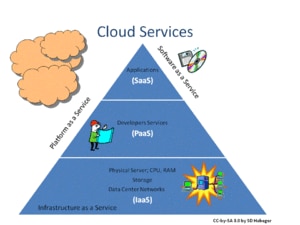
The 6 reasons why this will happen, according to Copeland, are:
- Mobile apps will drive enterprise cloud and private PaaS adoption
- Hybrid clouds will dominate the enterprise market in the end
- Smaller “public PaaS” players will dwindle as Infrastructure-as-a-Service (IaaS) subsumes PaaS
- 2013 PaaS purchase criterion: deployment acceleration. 2015 PaaS purchase criteria: administrative control, true polyglot development, easy extensibility to Big Data
- Beyond polyglot, “anyglot” development will move apps forward in ways we can’t yet imagine
- Agile development will be so agile we’ll need a new name for it: developers can work in the (fast) way that’s right for them
Sounds plausible? Read the full article by Copeland here.